Ragdolls are known for their calm personalities, but that does not mean they are comfortable with every sound. Ragdolls in noisy homes can often adjust to children, televisions, appliances, visitors, and normal household activity when they feel secure. However, every cat has a different tolerance for noise. Sudden shouting, construction, loud music, barking dogs, or constantly changing activity can become stressful for sensitive cats. The key is not creating a completely silent home. Instead, owners should give their Ragdolls predictable routines, quiet retreat areas, and control over when they interact with busy surroundings. When you understand your cat’s body language and introduce unfamiliar sounds gradually, a Ragdoll can often live comfortably in an active household without feeling overwhelmed.
Cats experience their environment differently from people. Their hearing is highly sensitive, so sounds that seem ordinary to us can be much more noticeable to them.
A vacuum cleaner, blender, doorbell, television, or excited group of children can suddenly change the atmosphere of a room. Some Ragdolls simply walk away. Others hide until the noise stops.
Neither response automatically indicates a serious problem. Moving away from an unpleasant sound is a normal way for a cat to manage its environment.
Problems can develop when the cat has nowhere to escape. Therefore, managing Ragdolls in noisy homes involves giving them choices rather than expecting them to tolerate constant activity.
How Ragdolls Usually Respond to Household Noise
Ragdolls often have a reputation for being relaxed and socially interested in their families. This temperament can help some individuals adapt to active homes.
A kitten raised around normal household sounds may become familiar with doors opening, people talking, televisions playing, and appliances running. These sounds eventually become part of everyday life.
However, early exposure does not guarantee that a cat will tolerate extreme noise. Sudden or unpredictable sounds can still trigger a startle response.
For example, a Ragdoll may remain completely relaxed while children play normally but run away when someone suddenly drops a heavy object. Context matters.
Frequency also matters when considering Ragdolls in noisy homes. Occasional noise gives a cat time to recover. Constant disruption can make relaxation more difficult.
Watch how quickly your cat returns to normal behavior after a loud event. A Ragdoll that briefly leaves the room and returns several minutes later may be coping well.
In contrast, a cat that remains hidden for hours after routine household sounds may need additional support.
Body language provides useful clues. A comfortable Ragdoll usually has a loose posture, neutral ears, and normal movement. It may sleep, groom, play, or eat despite ordinary activity around it.
A stressed cat can become tense. Its ears may flatten or rotate backward, while its pupils may become enlarged. The tail might remain tucked close to the body.
Some cats crouch low or immediately search for hiding places. Others become unusually alert and monitor every movement in the room.
Changes in daily behavior can provide stronger evidence than a single reaction. For example, frequent hiding, reduced appetite, excessive grooming, inappropriate elimination, or avoidance of family members can indicate ongoing stress.
Owners should also consider timing. If these behaviors appear after a major household change, environmental stress may be contributing.
A new baby, home renovation, frequent visitors, or a barking dog can dramatically alter a previously quiet environment.
Although Ragdolls in noisy homes may eventually adapt, adjustment should happen at the cat’s pace.
Give Your Ragdoll a Quiet Place to Retreat
One of the easiest ways to support a cat in an active household is to create a dependable quiet area.
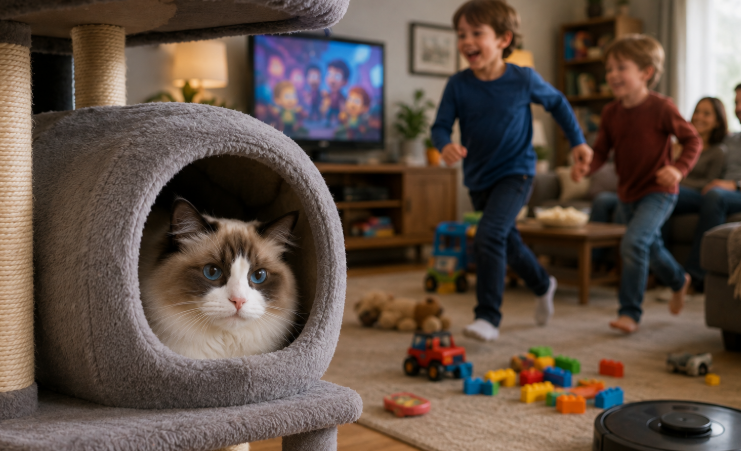
This space does not need to be an entire room. A comfortable bed in a low-traffic bedroom, a covered cat bed, or an elevated cat tree can provide valuable separation from household activity.
Ideally, your Ragdoll should be able to reach the area whenever it chooses. Avoid placing the only safe space somewhere that frequently becomes unavailable.
Cats often feel more secure when they have vertical options. A tall, stable cat tree or suitable shelf can allow your Ragdoll to observe activity without remaining directly in the middle of it.
Covered hiding spaces can also help. However, never pull a frightened cat out of its hiding place simply because you want it to socialize.
Allowing withdrawal can actually improve confidence. Your cat learns that it has control over its environment and can return when it feels ready.
This control is especially valuable for Ragdolls in noisy homes because complete elimination of household sound is rarely realistic.
Families with children should establish simple rules around the cat’s retreat area. When the Ragdoll goes to its bed, cat tree, or designated room, children should leave it alone.
Teach children not to chase a cat that walks away. Likewise, they should avoid shouting directly beside a sleeping cat or repeatedly picking it up during busy play.
Ragdolls can be affectionate family companions, but their gentle temperament should not be mistaken for unlimited patience.
Visitors also need boundaries. A social Ragdoll may approach guests voluntarily, while another may disappear until everyone leaves.
Do not force introductions. Let the cat decide whether it wants to participate.
During parties or large gatherings, consider setting up a separate secure room before guests arrive. Include food, water, litter, bedding, toys, and comfortable hiding places.
Make sure guests know that the room should remain closed. This arrangement can also reduce the chance of accidental escape through frequently opened exterior doors.
Introduce Loud Sounds Gradually When Possible
Some household sounds can be introduced slowly. Gradual exposure gives your Ragdoll an opportunity to learn that a sound is not dangerous.
For example, if your cat fears the vacuum cleaner, avoid turning it on directly beside the cat. Start using it farther away while your Ragdoll has access to a safe retreat.
Do not block escape routes or carry the cat toward the noise. Forced exposure can increase fear instead of reducing it.
Positive experiences can occur around mild versions of the sound. Play, affection, or treats may help when your cat remains relaxed.
However, food should never be used to lure a frightened cat closer to something it desperately wants to avoid.
When managing Ragdolls in noisy homes, owners should focus on gradual familiarity rather than forcing tolerance.
Construction presents a more difficult challenge because drilling, hammering, unfamiliar workers, and changing furniture can create several stressors simultaneously.
If renovation is temporary, keep your Ragdoll in a secure room located as far from the work as practical. Confirm that doors and windows remain secure.
Construction workers may frequently enter and exit the property. Therefore, escape prevention becomes particularly important.
Appliances can also cause short bursts of noise. Blenders, hair dryers, coffee grinders, washing machines, and vacuum cleaners may bother some cats more than others.
Whenever possible, allow your Ragdoll to leave before using a particularly loud appliance. A cat that chooses to remain nearby may already be comfortable with the sound.
Televisions and speakers deserve consideration as well. Avoid placing a cat’s primary sleeping area directly beside powerful speakers.
The fact that Ragdolls in noisy homes can adapt does not mean louder is better. Moderate sound levels create a more comfortable environment for people and pets.
Households with dogs may face additional challenges. A calm dog that occasionally barks is different from a dog that repeatedly chases the cat while barking.
In that situation, managing the interaction matters as much as managing noise. Your Ragdoll needs dog-free areas, elevated escape routes, and separate resources.
Never expect the cat to simply become accustomed to threatening behavior.
Maintain Predictable Routines in a Busy Household
Predictability can help balance an otherwise active environment. Cats often feel more secure when important parts of their day happen consistently.
Try to maintain reasonably stable feeding times. Regular interactive play can also give your Ragdoll a positive outlet for energy.
Keep litter boxes in accessible locations where sudden activity does not constantly interrupt the cat.
A litter box beside a noisy washing machine, for example, may become uncomfortable if the appliance frequently starts unexpectedly.
Place food and water away from areas where children run, doors slam, or dogs regularly disturb the cat.
These small adjustments can make Ragdolls in noisy homes feel more secure without requiring major changes to the family’s lifestyle.
Sleep also matters. Cats spend a significant amount of time resting, so they need places where they can sleep without repeated interruption.
A household can remain active while still respecting those resting periods.
If your family follows a predictable schedule, your Ragdoll may learn when the home is busiest and when it becomes quiet. This predictability can make everyday sounds less surprising.
Changes are sometimes unavoidable. A new baby, different work schedule, or visiting relatives can disrupt familiar routines.
When possible, introduce changes gradually. If a baby is expected, for example, prepare new furniture and household arrangements before the baby’s arrival.
Your cat then has time to investigate environmental changes separately from the new sounds and routines that will follow.
Similarly, if you are moving from a quiet apartment into a busy family home, begin by giving your Ragdoll a smaller secure area.
Gradual access can feel less overwhelming than immediate exposure to every person, pet, room, and sound.
Recognize When Noise Is Becoming Too Stressful
Occasional hiding after a loud event is usually different from chronic stress. Owners should focus on patterns rather than expecting a cat to remain completely unaffected by noise.
A Ragdoll that eats normally, plays, uses the litter box, seeks affection, and comfortably sleeps around everyday activity is probably adapting reasonably well.
However, persistent behavioral changes deserve attention. Cats experiencing stress may hide more often, avoid certain rooms, become irritable, or lose interest in normal activities.
Some cats groom excessively. Others may reduce grooming and develop a less tidy coat.
Appetite changes also matter. If your Ragdoll stops eating or shows a significant change in eating behavior, contact your veterinarian rather than assuming noise is the only explanation.
Litter box changes require similar caution. Stress can influence elimination behavior, but medical conditions can produce similar signs.
Therefore, inappropriate urination should not automatically be treated as a behavioral problem.
When Ragdolls in noisy homes suddenly begin acting differently, consider both environmental and medical possibilities.
A veterinary examination can help rule out health problems. If the cat is healthy but remains highly stressed, your veterinarian may recommend additional behavioral strategies.
You can also examine the home from your cat’s perspective. Identify where the loudest activities occur and whether the cat has practical escape routes.
Sometimes simple changes make a major difference. Moving a bed to another room, adding a cat tree, relocating the litter box, or limiting access to a busy area can improve comfort.
Noise-sensitive cats may also benefit from consistent background sound that masks unpredictable disturbances. Keep any background audio at a comfortable volume.
Most importantly, avoid punishing fear-related behavior. A frightened Ragdoll does not hide, scratch, or avoid people to misbehave.
Punishment can make the environment feel even less predictable and may weaken trust.
Can a Ragdoll Be Happy in a Busy Family Home?
Yes, many Ragdolls in noisy homes can live happy and comfortable lives. Normal household activity is not automatically harmful.
The important distinction is between a lively home and an environment where the cat can never escape overwhelming stimulation.
Children laughing, people talking, televisions playing, and everyday appliances are normal parts of family life. Many Ragdolls become familiar with these sounds.
However, the cat should still have opportunities to rest without interruption. Family members should respect its signals and provide safe areas.
Individual personality remains important. A confident Ragdoll raised in a busy household may barely react to ordinary activity.
A naturally cautious adult adopted from a quiet environment may require considerably more adjustment time.
Age can also influence responses. Young cats may adapt quickly to new routines, while older cats may prefer greater consistency.
Health conditions can change noise tolerance too. Pain or illness may make a normally relaxed cat more sensitive and irritable.
For these reasons, there is no single noise level that every Ragdoll can comfortably tolerate.
Rather than asking whether your home is too loud in general, observe how your individual cat behaves within it.
If your Ragdoll continues eating, sleeping, grooming, playing, and interacting normally, the household environment may be working well.
If stress signals become frequent, reduce unnecessary noise and increase access to quiet spaces.
Ultimately, Ragdolls in noisy homes usually do best when they have control over their surroundings. They do not need complete silence, but they do need somewhere peaceful to retreat.
A busy family can provide an excellent home for a Ragdoll when everyone respects the cat’s boundaries. Introduce unfamiliar sounds gradually, maintain predictable routines, and provide comfortable hiding and resting areas.
Most importantly, watch your cat rather than relying entirely on breed stereotypes. Ragdolls may be famous for their relaxed personalities, but each cat has an individual tolerance for noise. By creating a home with both social activity and peaceful retreat spaces, you can help your Ragdoll feel secure even when everyday family life gets loud.
FAQ
1. Are Ragdoll Cats Sensitive to Loud Sounds?
Some are more sensitive than others. Ragdolls may tolerate ordinary household sounds well while still becoming frightened by sudden shouting, construction, fireworks, or powerful appliances.
2. Can Ragdolls Live Comfortably With Noisy Children?
Yes, many can. Children should learn to respect the cat’s resting areas, avoid chasing it, and allow the Ragdoll to leave when it wants quiet time.
3. Why Does My Ragdoll Hide When I Vacuum?
Vacuum cleaners combine loud noise with movement, which can be intimidating. Give your cat access to another room or safe hiding place rather than forcing it to remain nearby.
4. Should I Keep My House Quiet for a Ragdoll Kitten?
Complete silence is unnecessary. Gentle exposure to normal household sounds can help a kitten become familiar with daily life, provided the experiences are not overwhelming.
5. How Do I Know If My Home Is Too Loud for My Cat?
Watch for persistent hiding, appetite changes, excessive grooming, irritability, or litter box changes. Although Ragdolls in noisy homes can adapt, ongoing behavioral changes may indicate stress or a medical issue.