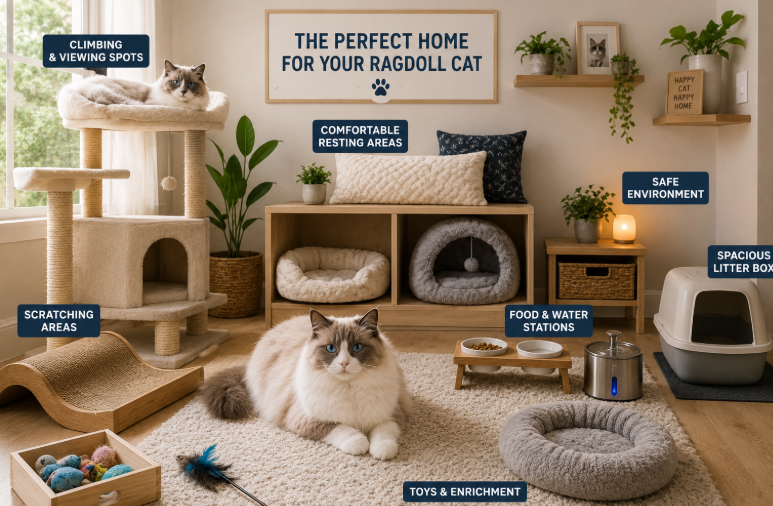
Bringing a Ragdoll into your home means creating an environment that supports more than eating and sleeping. A good Ragdoll cat home setup should provide comfortable resting areas, safe climbing opportunities, appropriate litter boxes, scratching surfaces, enrichment, and quiet places where your cat can retreat. Ragdolls are often affectionate and interested in family life, so they usually enjoy spaces that allow them to stay close to their people. However, they still need opportunities to rest without interruption. Their large size also means that some standard cat furniture, carriers, and litter boxes may feel cramped. By planning your home around natural feline behaviors and your individual cat’s preferences, you can create a space that feels secure, interesting, and comfortable throughout every stage of life.
You do not need a huge house or an expensive collection of cat products. Even a smaller apartment can work well when the available space is used thoughtfully.
Cats experience homes horizontally and vertically. Floors provide only one part of their usable territory. Cat trees, stable platforms, window perches, and suitable furniture can expand the environment upward.
Before buying anything, observe your home from your cat’s perspective. Look for quiet areas, busy walkways, sunny windows, potential hazards, and locations where essential resources can be separated.
This planning makes a Ragdoll cat home setup more functional rather than simply filling rooms with cat accessories.
Start With Safe and Comfortable Resting Areas
Cats spend a large portion of their day resting, so comfortable sleeping areas should be a priority.
Provide several options instead of expecting your Ragdoll to use one specific bed. Cats often change sleeping locations according to temperature, sunlight, household activity, and mood.
One bed might work well in a quiet bedroom, while another can sit near the family’s main living area.
Your Ragdoll may also choose the sofa, a window perch, or another safe surface. That is normal.
Because Ragdolls are large cats, check bed dimensions carefully. A small circular bed designed for a lightweight kitten may become uncomfortable once your cat reaches adult size.
A good Ragdoll cat home setup should account for adult proportions from the beginning whenever possible.
Choose stable furniture that can comfortably support your cat’s weight. This is particularly important with elevated beds and cat trees.
Tall structures should not wobble dramatically when the cat jumps onto them. Follow manufacturer instructions for assembly and securing furniture where appropriate.
Position resting areas away from hazards. Avoid unstable shelves, exposed electrical equipment, and places where a sleeping cat could easily fall.
Temperature also matters. A sunny window may become a favorite resting place during cooler weather but too warm at other times.
Make sure your Ragdoll can move away from heat whenever it chooses.
Quiet retreat spaces are equally important. Even a highly social cat occasionally needs privacy.
A covered bed, open carrier, cardboard box, or quiet corner can provide a sense of security.
Do not disturb your cat every time it enters a hiding space. Allowing uninterrupted rest helps make the area genuinely useful.
Children should understand this rule as well. When the Ragdoll enters its designated quiet area, family members should give it space.
Choose Litter Boxes That Fit a Large Ragdoll
Litter box design can significantly affect a cat’s comfort. Ragdolls may become much larger than the average domestic cat, so compact boxes can be restrictive.
Your cat should have enough room to enter, turn around, dig, and position itself comfortably.
When planning a Ragdoll cat home setup, choose generously sized litter boxes. Some owners find that large open boxes provide more usable room than enclosed models.
Placement is just as important as size.
Put litter boxes somewhere accessible but reasonably quiet. Avoid locations where loud appliances suddenly start or people constantly walk past.
A box beside a washing machine, for example, might seem convenient for humans but uncomfortable for a noise-sensitive cat.
In multi-level homes, having litter facilities on more than one floor may improve accessibility.
Multiple cats require additional planning because sharing a single box can create competition or avoidance.
A commonly used starting guideline is one litter box per cat plus one additional box. However, the exact arrangement should also consider your cats, home layout, and available space.
Spread boxes across different areas rather than placing every box side by side. Boxes grouped together may function more like one resource from a cat’s perspective.
Keep them clean. Scoop regularly and replace litter as needed.
Cats can develop preferences for litter texture and depth, so avoid unnecessary sudden changes once you find an option your Ragdoll uses comfortably.
Strongly scented products are not always better. A fragrance that seems pleasant to people may be overwhelming to a cat’s sensitive nose.
Watch for changes in litter box behavior. Straining, repeated unsuccessful attempts to urinate, blood, crying, or sudden avoidance can indicate a medical problem.
Do not assume elimination changes are simply bad behavior. Veterinary attention may be necessary.
Create Dedicated Feeding and Hydration Areas
Food and water deserve thoughtful placement too.
Choose an area where your Ragdoll can eat without being constantly disturbed by people or other pets.
If dogs live in the home, make sure they cannot repeatedly steal the cat’s food or interrupt meals.
In multi-cat households, separate feeding locations may reduce competition.
A successful Ragdoll cat home setup should make important resources easy to access without forcing your cat into stressful interactions.
Water can be offered in more than one location. Some cats drink more readily when fresh water is conveniently available throughout the home.
Use clean bowls and refresh water regularly.
Some cats enjoy drinking fountains. If you use one, follow cleaning instructions carefully because pumps and internal surfaces can accumulate residue.
Food and water bowls should be appropriate for the cat and easy to wash.
Monitor how your individual Ragdoll prefers to eat and drink rather than assuming one bowl style is universally best.
Keep feeding areas separate from litter boxes. Cats generally benefit when eating, drinking, and elimination resources are not crowded into one small space.
If your Ragdoll eats too quickly, certain feeding puzzles or slow-feeding strategies may provide enrichment. However, introduce them gradually.
Start with easy puzzles so your cat learns how to access the food without becoming frustrated.
Diet should remain nutritionally complete and appropriate for your cat’s age, body condition, and health needs.
Ragdolls can appear larger because of their substantial coats, so monitor body condition rather than relying only on visual size.
Your veterinarian can help you determine appropriate feeding amounts and healthy weight targets.
Add Scratching, Climbing, and Play Opportunities
Scratching is normal feline behavior. Cats scratch to maintain their claws, stretch their bodies, communicate through scent and visual marks, and interact with their environment.
Instead of trying to stop scratching completely, provide appropriate surfaces.
A scratching post should be tall enough for your Ragdoll to stretch comfortably. It should also remain stable when a large cat pulls against it.
Some cats prefer vertical scratching posts, while others enjoy horizontal cardboard scratchers. Offering both can help reveal your cat’s preference.
Place scratchers where your cat naturally wants to scratch.
A post hidden in an unused room may receive less attention than one near a sleeping area, doorway, or family space.
Including several scratching locations makes a Ragdoll cat home setup more compatible with natural feline behavior.
Climbing opportunities provide another form of enrichment. Ragdolls may not always be as intensely athletic as some breeds, but many still enjoy elevated viewpoints.
Choose sturdy cat trees with platforms large enough to support an adult Ragdoll comfortably.
Window perches can be especially interesting. Watching birds, people, leaves, and outdoor movement provides passive stimulation.
Make sure windows and screens are secure. Never assume an ordinary insect screen can safely contain a determined cat.
Interactive play should also be part of the environment.
Wand toys can encourage stalking, chasing, and pouncing. Move the toy like prey rather than simply waving it directly in your cat’s face.
Allow your Ragdoll to catch the toy occasionally. A successful capture can make the play sequence more satisfying.
Store string-like toys safely when you are not supervising. Loose strings, ribbons, yarn, and similar materials can be dangerous if swallowed.
Rotate toys periodically. You do not need dozens available at once.
Keeping some toys stored and reintroducing them later can renew interest without constantly buying new products.
Make Your Home Safer for a Curious Ragdoll
Cat-proofing is an important part of any Ragdoll cat home setup. Even calm cats can become curious when something new appears.
Secure medications, household chemicals, cleaning products, and other potentially dangerous substances.
Keep small objects that could be swallowed out of reach.
Pay attention to cords, strings, rubber bands, hair ties, thread, and similar items. Some cats are attracted to these objects, but swallowing them can cause serious problems.
Check plants before bringing them into your home. Some common houseplants are toxic to cats.
Lilies are particularly dangerous to cats and should not be accessible in a cat household.
When you are unsure whether a plant is safe, verify it using a reliable veterinary or animal poison-control resource.
Windows and balconies require special attention. Install secure barriers where needed and inspect screens regularly.
A Ragdoll should not be allowed onto an unsecured balcony simply because it normally behaves calmly.
Accidents can happen when a bird, insect, sudden noise, or unexpected movement attracts the cat’s attention.
Electrical cords may also need management, particularly with kittens that enjoy chewing.
Use appropriate cord management solutions and unplug unnecessary equipment when practical.
Inspect reclining chairs and similar furniture before operating them if your cat likes hiding nearby. Cats can enter unexpected spaces beneath furniture.
Washers and dryers should also remain closed when not being loaded. Check the drum before starting a cycle.
These precautions may feel excessive at first, but they quickly become normal household habits.
Build a Home Around Routine and Social Connection
Ragdolls often enjoy being involved in family activities. Therefore, the perfect cat environment should not isolate them from everyone.
Place some beds, scratchers, and climbing structures in rooms where your household spends time.
A cat tree in the living room may receive far more use than one hidden in an empty room.
This allows your Ragdoll to participate without needing constant physical attention.
At the same time, maintain quiet alternatives. The best Ragdoll cat home setup gives your cat choices between social interaction and privacy.
Predictable routines can make the environment feel safer.
Try to keep feeding, play, and grooming reasonably consistent. Exact times are unnecessary, but a recognizable daily pattern can help.
Regular grooming is especially useful for a Ragdoll’s medium-to-long coat.
Keep grooming tools somewhere convenient so brushing becomes an easy part of the routine rather than a major event.
Introduce grooming gradually to kittens and newly adopted adults. Short positive sessions can help build tolerance.
Check the coat for tangles, particularly around areas where friction occurs.
Nail care, dental care, and routine veterinary appointments should also be incorporated into long-term care.
The home environment cannot replace preventive healthcare, but it can make daily care easier.
For example, leaving the carrier accessible can prevent it from becoming something that appears only before stressful veterinary trips.
Place comfortable bedding inside and allow your Ragdoll to explore it voluntarily.
The carrier can even become another resting spot.
Adjust the Home as Your Ragdoll Gets Older
A perfect home is not a permanent arrangement. Your Ragdoll’s needs will change throughout life.
Kittens may need more active play, extra supervision, and careful management of small hazards.
Adults often settle into predictable preferences for sleeping, scratching, and social interaction.
Senior cats may need easier access to essential resources.
An older Ragdoll with reduced mobility might struggle with a litter box that has very high sides. It may also find tall cat trees difficult to climb.
Add lower resting platforms, ramps, or steps where appropriate.
Move essential resources so your cat does not need to navigate difficult stairs repeatedly.
Soft, supportive sleeping surfaces may become more appealing with age.
Keep food, water, and litter accessible while still maintaining separation between these resources.
Watch for changes rather than assuming reduced activity is simply normal aging.
Difficulty jumping, stiffness, changes in grooming, litter box problems, or unusual withdrawal can indicate discomfort.
Discuss significant changes with your veterinarian.
Adapting your Ragdoll cat home setup over time helps maintain independence and comfort as your cat ages.
Ultimately, the perfect home for a Ragdoll is not the one with the most expensive cat furniture. It is the home that consistently meets the cat’s physical, behavioral, and emotional needs.
Provide enough space for your Ragdoll to rest, scratch, climb, play, eat, drink, and use the litter box comfortably.
Make safety a priority by securing windows, removing toxic hazards, and keeping dangerous objects inaccessible.
Give your cat social opportunities without forcing interaction. Likewise, provide peaceful areas where it can retreat when family life becomes busy.
A thoughtful Ragdoll cat home setup combines these elements into an environment that gives your cat choices. As you learn your Ragdoll’s preferences, adjust the home accordingly. That flexibility can turn even a modest living space into a comfortable, stimulating, and secure home where your Ragdoll can thrive for years.
FAQ
1. Do Ragdoll Cats Need a Large House?
No. Ragdolls can live comfortably in apartments and smaller homes when they have appropriate resting spaces, scratching surfaces, enrichment, and vertical territory.
2. What Size Litter Box Is Best for a Ragdoll?
Choose a generously sized box that allows your cat to enter, turn, dig, and position itself comfortably. Adult Ragdolls often need larger boxes than typical cats.
3. Do Ragdolls Need a Cat Tree?
A cat tree is not mandatory, but a sturdy climbing structure can provide exercise, scratching opportunities, observation areas, and comfortable elevated resting spaces.
4. Where Should a Ragdoll Sleep?
Offer several safe sleeping options in both social and quiet areas. Your cat may change locations throughout the day depending on temperature and household activity.
5. What Is Most Important in a Ragdoll-Friendly Home?
Safety, accessible resources, enrichment, comfortable resting areas, and opportunities for both social interaction and privacy are essential. A good Ragdoll cat home setup should also change as your cat’s needs evolve.