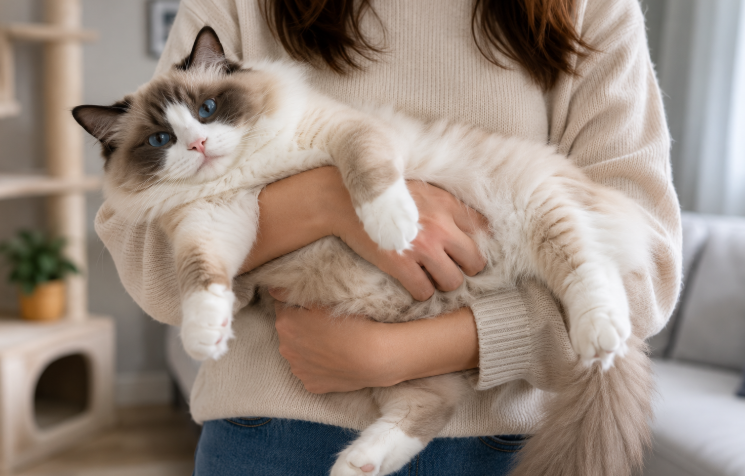
One of the most famous stories about the Ragdoll breed is that these cats relax completely when someone picks them up. In fact, the tendency for some Ragdoll cats go limp in a trusted person’s arms helped inspire the breed’s memorable name. However, the reality is more nuanced than the popular description suggests. Some Ragdolls become remarkably relaxed when held, while others prefer keeping their feet firmly on the ground. A limp posture can reflect trust, a calm temperament, comfortable handling, or simply an individual preference. It should never be treated as a behavior every Ragdoll must display. Understanding the difference between comfortable relaxation and physical weakness is also important. By learning your cat’s normal body language, you can enjoy affectionate handling while respecting personal boundaries and recognizing signs that deserve veterinary attention.
Ragdolls are often described as gentle and easygoing. Many enjoy staying near their families and may tolerate handling better than some more independent cats. However, breed tendencies do not determine every individual’s personality.
Genetics, early socialization, previous experiences, health, and handling all influence how a cat responds to being picked up. A Ragdoll raised around gentle human contact may become comfortable in someone’s arms. Another perfectly healthy Ragdoll may prefer affection while sitting beside you.
Therefore, owners should not repeatedly test whether their Ragdoll cats go limp simply because they have heard about the trait. Your cat does not need to become floppy to prove that it is a genuine Ragdoll or that it trusts you.
Instead, observe how your cat behaves naturally. A relaxed Ragdoll may soften its muscles, rest against your body, keep its ears neutral, and show little desire to escape. These signals provide more useful information than whether the legs hang loosely.
Why Some Ragdolls Relax So Deeply When Held
The relaxed reputation of the breed is connected with temperament. Ragdolls were developed with an emphasis on companionable characteristics, and many individuals display calm, people-oriented behavior.
When a cat feels safe in someone’s arms, its muscles may relax. Rather than preparing to jump away, the cat allows its body to rest against the person providing support. This can create the floppy appearance associated with Ragdolls.
Trust plays an important role. Cats are physically vulnerable when lifted because they lose direct control over where their bodies move. A cat that remains relaxed is often comfortable with the person and the situation.
However, trust does not mean unlimited tolerance. Even cats that normally enjoy being carried may want to get down after a short period.
Some Ragdoll cats go limp more readily with one family member than another. Familiarity, handling technique, scent, voice, and previous interactions can all affect how secure the cat feels.
Proper physical support also matters. A cat may relax more when its chest and hindquarters feel stable. In contrast, dangling without support can make a cat uncomfortable.
Always support the body securely when lifting your Ragdoll. Place one hand around the chest area and use the other to support the hindquarters. Keep the cat close to your body rather than holding it far away.
Ragdolls can become large adults, so supporting their weight is especially important. Never lift an adult cat by the front legs, scruff, or another unsupported body part.
Once your Ragdoll is in your arms, pay attention to body language. Relaxed ears, soft facial muscles, normal breathing, and a loose body can indicate comfort.
A tense cat looks different. Its muscles may become rigid, paws may spread, ears may rotate backward, and the tail may move sharply. The cat might also turn its head repeatedly toward the floor while searching for an escape route.
If these signs appear, lower the cat carefully rather than waiting for it to struggle. Respecting early signals can make future handling easier because your Ragdoll learns that it can communicate without escalating.
The famous way some Ragdoll cats go limp should therefore be viewed as one possible expression of relaxation, not a requirement.
Personality creates plenty of variation within the breed. Some Ragdolls love being carried around the house. Others tolerate a brief lift before asking to return to the floor.
Both behaviors are normal when the cat appears healthy and comfortable.
Does Going Limp Mean Your Ragdoll Trusts You?
A relaxed body can certainly suggest that your cat feels safe. However, owners should avoid using one behavior as a complete measurement of trust.
Cats express comfort in many ways. Your Ragdoll may choose to sleep beside you, follow you between rooms, approach with an upright tail, rub against you, or seek gentle petting.
Slow blinking and relaxed resting nearby can also occur during comfortable social interactions. Some cats show affection without ever becoming enthusiastic about being picked up.
Consequently, whether Ragdoll cats go limp should not determine how strong their bond with an owner appears to be. A cat that dislikes being carried can still have an extremely close relationship with its family.
Early handling may influence comfort. Kittens that experience gentle, positive handling can learn that being touched and briefly lifted is safe.
However, socialization should never involve forcing a frightened kitten to remain in someone’s arms. Short positive interactions are more useful than overwhelming experiences.
Adult cats can also become more comfortable with handling over time. Start with interactions your cat already enjoys. Then gradually introduce brief lifting if necessary.
For example, gently lift the cat only slightly before placing it back down. Follow the interaction with something positive, such as affection, play, or an appropriate treat.
Increase the duration gradually if your Ragdoll remains relaxed. If the cat struggles, return to an easier step.
Some cats simply dislike losing contact with the floor. Their preference does not need to be changed unless handling is necessary for grooming, veterinary care, transportation, or another practical reason.
Even then, the goal should be tolerance and safety rather than creating a floppy cat.
Children need special guidance when handling Ragdolls. A relaxed cat can appear similar to a stuffed toy, which may encourage a child to carry it incorrectly.
Teach children that the cat must have its body supported. They should never drag, squeeze, swing, or hold the cat against its wishes.
Adult supervision is especially important with younger children. A large Ragdoll can become difficult to hold safely if it suddenly decides to jump down.
When Ragdoll cats go limp, their relaxed posture can make owners forget how much they weigh. Maintain secure support even when the cat seems completely comfortable.
Never assume a relaxed cat will remain still indefinitely. A sudden sound, movement, or unfamiliar person can cause an immediate attempt to escape.
Know the Difference Between Relaxation and Weakness
There is an important distinction between a Ragdoll relaxing in someone’s arms and a cat becoming physically limp because something is wrong.
Normal relaxation occurs in context. Your cat is alert before being picked up, responds normally, and returns to ordinary behavior afterward.
For example, a relaxed Ragdoll might lie loosely against your arms. Once placed on the floor, it walks away normally, eats, plays, grooms, and behaves as expected.
Medical weakness can look very different. A cat may struggle to stand, appear unusually sleepy, collapse, breathe abnormally, or fail to respond normally to its surroundings.
Therefore, the fact that some Ragdoll cats go limp should never cause owners to dismiss sudden weakness as a breed characteristic.
If your Ragdoll unexpectedly becomes limp when it normally does not, evaluate the situation carefully. Sudden loss of strength deserves prompt attention.
Other concerning signs include difficulty walking, poor coordination, unusual breathing, pale or abnormal-looking gums, repeated vomiting, seizures, collapse, or extreme lethargy.
Contact a veterinarian promptly when significant weakness appears. If your cat collapses, has difficulty breathing, or appears severely unwell, seek urgent veterinary care.
Pain can also change how a cat responds to handling. A Ragdoll that previously enjoyed being carried may suddenly resist being picked up.
It might vocalize, tense its body, bite, scratch, or attempt to escape. These changes can indicate discomfort rather than a personality shift.
Joint pain, injuries, abdominal discomfort, or other medical problems may make lifting unpleasant. Therefore, a sudden change in handling tolerance deserves attention.
Older Ragdolls may also become less comfortable being carried. Arthritis and reduced mobility can make certain positions painful.
Adjust your handling technique as your cat ages. Provide full support and avoid twisting the body unnecessarily.
Routine veterinary care can help identify health conditions that affect movement and comfort. Mention changes in handling tolerance during appointments, even if they seem minor.
Understanding the difference between relaxed behavior and physical weakness makes the reputation that Ragdoll cats go limp much safer to interpret.
How to Hold a Ragdoll Comfortably and Safely
Safe handling begins before you lift the cat. Approach calmly and avoid surprising a sleeping or distracted Ragdoll.
Let your cat see or smell your hand first. Gentle contact can help you judge whether the cat welcomes interaction.
When lifting, support both the front portion of the body and the hindquarters. Keep the spine in a comfortable position and bring the cat close to your torso.
Never allow the entire rear half of a large Ragdoll to hang unsupported. Good support can make the experience more comfortable and reduce strain.
If your Ragdoll cats go limp during handling, continue supporting the body. Relaxation does not mean the cat suddenly needs less physical support.
Watch the tail and ears while holding your cat. These areas often reveal changes in mood before obvious struggling begins.
A tail that starts flicking rapidly may indicate growing irritation. Flattened or sideways ears can also suggest discomfort.
Your Ragdoll may shift its weight toward the floor when it wants to get down. Respond early by lowering the cat carefully onto a stable surface.
Never drop or release the cat from a significant height. Even if cats often land on their feet, awkward falls can cause injuries.
Keep handling sessions short when training a cat that feels uncertain. One calm ten-second lift can be more useful than holding the cat until it struggles.
You can gradually increase the time as comfort develops. However, some Ragdolls will always prefer short handling periods.
Visitors should follow the same boundaries. A friendly Ragdoll may approach guests for attention without wanting to be lifted by them.
Ask visitors to pet the cat gently and allow it to initiate contact. Avoid passing the cat between people during gatherings.
The same principle applies at home: whether Ragdoll cats go limp is less important than whether they remain comfortable.
Respect Your Ragdoll’s Individual Personality
Breed descriptions are useful because they provide general expectations. However, they can become misleading when owners treat them as guarantees.
Not every Ragdoll is extremely relaxed. Some are energetic, vocal, independent, cautious, or selective about physical affection.
A Ragdoll that dislikes being held is not behaving incorrectly. It may simply prefer another form of interaction.
Instead of focusing on carrying, discover what your cat enjoys. It might love brushing, interactive play, sitting beside you, or sleeping near your feet.
Building trust means respecting those preferences. When a cat learns that people listen to its signals, interactions often become calmer.
Likewise, never purchase or adopt a Ragdoll solely because you expect a cat that can be carried like a doll. Personality varies, and circumstances can change throughout the cat’s life.
Kittens may become more or less tolerant of handling as they mature. Adults may change after stressful experiences, illness, or environmental changes.
For this reason, statements that all Ragdoll cats go limp oversimplify a much more interesting breed.
The behavior is better understood as a tendency reported in some individuals. A relaxed temperament may make certain Ragdolls especially comfortable with handling, but each cat retains personal preferences.
Owners should focus on the whole animal rather than one famous characteristic. Look for normal appetite, healthy movement, curiosity, social engagement, grooming, play, and relaxed behavior.
When your Ragdoll enjoys being carried, handle it with full physical support and pay attention to subtle signals. When it prefers the floor, respect that preference and find other ways to bond.
Most importantly, never confuse sudden weakness with normal relaxation. A healthy cat that relaxes in your arms should return to normal activity once placed down.
Ultimately, the reason some Ragdoll cats go limp when held is usually connected with their relaxed temperament, comfort, and trust during handling. However, the behavior varies widely and should never define whether a Ragdoll is affectionate or authentic. Support your cat properly, respect its boundaries, and learn its normal body language. Those habits matter far more than whether your Ragdoll lives up to its famously floppy reputation.
FAQ
1. Do All Ragdoll Cats Become Limp When Picked Up?
No. Some Ragdolls relax deeply when held, while others prefer remaining on the floor. Both responses can be normal for healthy cats.
2. Does a Floppy Ragdoll Mean the Cat Trusts Me?
A relaxed posture can suggest comfort, but trust appears through many behaviors. Following you, resting nearby, seeking contact, and relaxed body language can also show a strong bond.
3. Why Does My Ragdoll Suddenly Want to Get Down?
Your cat may simply have reached its handling limit. Noise, discomfort, heat, excitement, or a desire to explore can also make a previously relaxed cat want to move.
4. What Is the Safest Way to Carry a Large Ragdoll?
Support the chest and hindquarters while keeping the cat close to your body. Never allow the rear body to dangle or lift the cat by its legs or scruff.
5. When Should Limpness Become a Health Concern?
Seek veterinary help if limpness occurs with weakness, collapse, poor coordination, abnormal breathing, or unusual responsiveness. Although some Ragdoll cats go limp while relaxed, sudden physical weakness is not a normal breed trait.