A sudden change in your Ragdoll’s personality can be confusing, especially when a normally relaxed cat starts hiding, vocalizing, avoiding people, scratching furniture, or behaving differently around the litter box. Unusual Ragdoll cat behavior should not immediately be treated as disobedience. Cats communicate through their actions, so behavioral changes can indicate stress, discomfort, environmental disruption, boredom, fear, or a medical problem. Punishment rarely solves the underlying issue and can make an anxious cat even more unsettled. Instead, owners should observe when the behavior started, look for changes around the home, protect important routines, and rule out health concerns when necessary. A calm approach helps you understand what your Ragdoll may be communicating while protecting the trust you have already built.
Ragdolls are often described as gentle and easygoing. However, this reputation can sometimes cause owners to overlook behavioral changes because they expect the breed to remain relaxed in every situation.
Individual Ragdolls have different personalities and stress thresholds. Some adapt quickly when routines change, while others need much more time.
A behavior that seems unusual to you may also be normal feline behavior occurring in an inconvenient place. Scratching, climbing, hiding, hunting, and nighttime activity are natural behaviors.
The goal should not be to eliminate normal instincts. Instead, owners can provide acceptable outlets while investigating genuinely concerning changes.
Understanding this difference is an important first step when addressing Unusual Ragdoll cat behavior without creating additional stress.
Start by Looking for the Cause of the Behavior
Behavior problems are easier to address when you understand what happened before they appeared. Think about changes that occurred during the previous days or weeks.
Did someone move into the home? Did another pet arrive? Have you changed your work schedule, cat litter, food, furniture, or sleeping arrangements?
Even relatively small changes can affect some cats. Moving a litter box to another room, for example, can disrupt a familiar routine.
Visitors, construction, loud appliances, new pets, and unfamiliar smells may also influence behavior.
When evaluating Unusual Ragdoll cat behavior, write down what happens before and after each incident. Patterns can reveal useful clues.
Suppose your Ragdoll suddenly hides every evening. You might discover that the behavior begins when a loud appliance starts or when children return home.
Another cat may become vocal before meals because the feeding schedule has changed. A third may scratch furniture after losing access to its preferred scratching surface.
Observation gives you something specific to address rather than relying on guesswork.
However, behavioral changes can also have medical causes. Cats cannot explain when something hurts, so discomfort may first appear as avoidance, aggression, hiding, or changes in daily routines.
A cat with painful joints might stop jumping onto a favorite bed. Dental discomfort could affect eating. Urinary problems may cause litter box changes.
Therefore, sudden Unusual Ragdoll cat behavior deserves careful attention, especially when no environmental explanation is obvious.
Watch for changes in appetite, drinking, urination, bowel movements, mobility, grooming, breathing, or sleep.
Unexpected weight changes, repeated vomiting, diarrhea, weakness, or obvious pain also require veterinary attention.
If your cat suddenly stops eating, has difficulty urinating, struggles to breathe, collapses, or appears severely unwell, seek veterinary care promptly.
Do not assume that every behavioral problem can be solved through training.
Once medical concerns have been appropriately addressed, you can focus more confidently on environmental and behavioral causes.
Avoid Punishment and Reduce Sources of Stress
Yelling, spraying water, hitting, chasing, or physically forcing a cat rarely teaches the lesson an owner intends.
Instead, the cat may associate the frightening experience with you, another person, or the location where it occurred.
For example, punishing a Ragdoll beside the litter box may make that area feel even less safe. The original problem can then become harder to solve.
A calmer strategy is particularly important with Unusual Ragdoll cat behavior because fear can hide the actual cause.
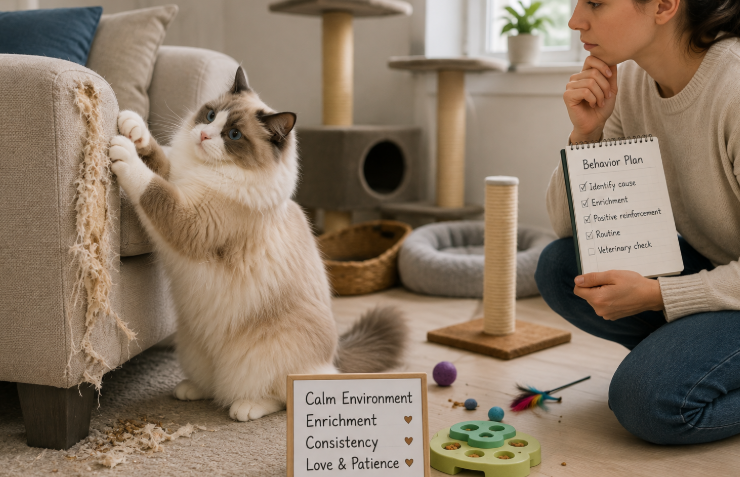
If your cat scratches a sofa, provide an attractive scratching surface nearby. Experiment with vertical and horizontal options because cats can have preferences.
Reward appropriate scratching with attention, play, or treats when suitable. Meanwhile, make the furniture less appealing using safe management strategies.
If your cat repeatedly jumps onto a surface where it should not be, consider why. It may be searching for height, warmth, food, attention, or an interesting view.
Providing a better alternative can be more effective than repeatedly removing the cat.
A tall cat tree near a window, for example, can satisfy climbing and observation needs.
Hiding should also be handled carefully. A frightened cat needs a safe place to recover.
Do not drag your Ragdoll from underneath furniture simply to make it socialize. Instead, provide accessible hiding spaces such as covered beds, boxes, or quiet resting areas.
Allow the cat to emerge voluntarily when possible.
Reducing household conflict can also improve Unusual Ragdoll cat behavior. In multi-cat homes, tension is not always obvious.
One cat may quietly block another from reaching food, water, litter boxes, doorways, or favorite resting places.
Provide multiple important resources in separate areas. This reduces the need for cats to compete over a single location.
Litter box setup deserves particular attention. Keep boxes accessible, appropriately sized, and regularly cleaned.
A large Ragdoll may find a small litter box uncomfortable. Additionally, placing the box beside a noisy appliance or busy doorway may discourage use.
Avoid sudden litter changes when possible. Cats can be sensitive to texture, scent, depth, and box style.
If elimination problems develop, veterinary evaluation is important because urinary and digestive conditions can resemble behavioral issues.
Restore Predictable Routines and Healthy Activity
Cats often benefit from predictable routines because consistency makes their environment easier to understand.
Feeding, play, grooming, and quiet interaction do not need to happen at the exact minute every day. However, a reasonably stable pattern can provide reassurance.
This is especially useful after moving, changing work schedules, introducing another pet, or experiencing other household disruptions.
If Unusual Ragdoll cat behavior begins after a routine change, rebuild predictability around the parts of the day you can control.
Interactive play is another valuable tool. Although Ragdolls may appear relaxed, they still need opportunities to chase, stalk, pounce, climb, and explore.
Use wand toys and other appropriate interactive toys to encourage movement. Short play sessions can be easier to maintain than one long session.
Allow your cat to experience a satisfying sequence of chasing and catching during play. Avoid simply waving a toy continuously where the cat can never reach it.
Rotate toys instead of leaving every item available all the time. Rotation can make familiar objects feel interesting again.
Food puzzles may provide additional mental stimulation for suitable cats. Start with an easy puzzle so your Ragdoll learns how it works without frustration.
Environmental enrichment can help when Unusual Ragdoll cat behavior is connected with boredom.
Window perches, stable climbing structures, scratching posts, tunnels, and comfortable elevated resting areas can make indoor environments more interesting.
However, enrichment should fit your individual cat. A senior Ragdoll with reduced mobility may prefer low platforms rather than tall climbing structures.
Affection should also follow your cat’s preferences. Some Ragdolls enjoy extensive physical contact, while others want shorter interactions.
Watch for signs that your cat has had enough. Tail movement, skin twitching, turning the head toward your hand, flattened ears, or attempts to leave can indicate overstimulation.
Stop before your cat feels the need to scratch or bite.
Respecting these signals teaches your Ragdoll that communication works. As a result, interactions may become calmer.
Handle Common Behavior Changes Without Creating Fear
Excessive vocalization is one behavior owners may notice. First, determine when it occurs.
A Ragdoll may vocalize because it wants food, attention, play, access to another room, or interaction with someone nearby.
However, sudden excessive vocalization can also occur with discomfort or medical changes, particularly in older cats.
Do not automatically reward every demand with food. Instead, identify the likely need and maintain appropriate routines.
Nighttime activity can also frustrate owners. Cats naturally have activity patterns that may not perfectly match human schedules.
An interactive play session followed by the normal evening feeding routine may help some cats settle.
Avoid turning nighttime misbehavior into an exciting game of chasing your cat around the house.
Another form of Unusual Ragdoll cat behavior is sudden avoidance. A social Ragdoll may begin spending more time alone.
Consider whether something changed in its preferred social area. New furniture, visitors, another pet, or repeated handling can influence where the cat chooses to rest.
Do not force the cat back into its previous routine. Provide comfortable alternatives and allow confidence to return gradually.
Aggressive behavior requires particular care. A Ragdoll that suddenly swats, bites, or growls may be frightened, overstimulated, frustrated, or experiencing pain.
Give the cat space. Avoid physical punishment or confrontation.
If aggression is new, severe, unpredictable, or associated with possible pain, speak with a veterinarian.
Redirected aggression can occur when a cat becomes highly aroused by something it cannot reach. For example, seeing an unfamiliar outdoor cat through a window may trigger intense excitement.
The Ragdoll may then react toward another pet or person nearby.
In these situations, separate animals safely and allow the cat time to calm down. Avoid reaching toward an extremely aroused cat with bare hands.
Changes in grooming can also provide clues. Excessive licking may be associated with skin problems, parasites, pain, or stress.
Reduced grooming can occur when a cat feels unwell or has difficulty reaching certain areas.
Because Ragdolls have substantial coats, grooming changes may become particularly noticeable. Veterinary guidance can help determine whether there is a physical cause.
Make Changes Gradually and Track What Works
Trying several major solutions at once can make it difficult to know what actually helped.
Instead, identify the most likely cause and make manageable adjustments. Keep notes about your Ragdoll’s behavior over several days.
Record when the behavior happens, how long it lasts, who is present, and what occurred immediately beforehand.
This simple record can make Unusual Ragdoll cat behavior easier to understand.
For example, you may discover that scratching increases when your cat has missed its evening play session.
Another pattern may show that hiding occurs mainly when visitors bring a dog into the house.
Once you identify a pattern, modify the environment and observe whether the frequency or intensity changes.
Progress may be gradual. A stressed cat does not always return to normal immediately after the original trigger disappears.
Give your Ragdoll time to rebuild confidence. Maintain predictable resources and avoid overwhelming it with repeated attempts to socialize.
Positive reinforcement can support desired behavior. When your cat uses the scratching post, relaxes calmly around visitors, or enters its carrier voluntarily, reinforce that experience appropriately.
Rewards can include treats, play, affection, or access to something the cat enjoys.
The reward should match the individual cat. Not every Ragdoll values the same things.
Avoid expecting perfection. Behavior can fluctuate, especially during household changes.
A good plan should reduce stress and improve your cat’s overall quality of life rather than simply stop one inconvenient action.
Know When Professional Help Is Necessary
Many mild behavior changes improve when owners address environmental stress, restore routines, and provide appropriate enrichment.
However, some problems require professional support.
Start with your veterinarian when a behavior is sudden, severe, or accompanied by physical symptoms.
Medical evaluation is particularly important for litter box changes, aggression, reduced appetite, unusual vocalization, mobility problems, or major personality changes.
If health problems have been ruled out but Unusual Ragdoll cat behavior continues, professional behavioral guidance may be helpful.
A qualified feline behavior professional can examine the environment, triggers, routines, and interactions in greater detail.
Bring your behavior notes because specific examples are more useful than general descriptions.
Videos may also help when they can be recorded safely without deliberately provoking the behavior.
Never create a stressful situation simply to capture footage.
The sooner persistent problems are addressed, the easier they may be to manage. Waiting until a behavior becomes deeply established can make improvement more difficult.
Most importantly, remember that your Ragdoll is not trying to make your life difficult. Behavior has a purpose, even when that purpose is not immediately obvious.
Your job is to identify what changed, what your cat needs, and whether health concerns may be involved.
Ultimately, resolving Unusual Ragdoll cat behavior without stress requires observation, patience, and practical environmental changes. Avoid punishment and focus on causes rather than symptoms. Maintain familiar routines, provide appropriate outlets for natural feline behavior, and respect your cat’s boundaries. When sudden changes or physical symptoms appear, involve your veterinarian. A calm approach protects your relationship with your Ragdoll while giving you a much better chance of solving the real problem behind the behavior.
FAQ
1. Why Has My Ragdoll Suddenly Started Acting Differently?
Sudden changes can result from stress, household changes, pain, illness, boredom, or changes in daily routines. Consider recent environmental changes and contact your veterinarian if the behavior is significant or unexplained.
2. Should I Punish My Ragdoll for Bad Behavior?
No. Punishment can increase fear and stress without addressing the cause. Redirect natural behaviors toward acceptable alternatives and reinforce appropriate choices.
3. Why Is My Normally Social Ragdoll Suddenly Hiding?
Hiding may occur after loud noises, visitors, environmental changes, conflict with another pet, or illness. Give your cat a safe retreat and investigate persistent changes.
4. Can Boredom Cause Behavior Problems in Ragdoll Cats?
Yes. Indoor cats benefit from interactive play, scratching surfaces, climbing opportunities, exploration, and mental stimulation. Appropriate enrichment can reduce behaviors linked to insufficient activity.
5. When Should I Take My Ragdoll to the Veterinarian for Behavior Changes?
Seek veterinary guidance when changes are sudden, persistent, severe, or accompanied by appetite, litter box, mobility, grooming, or physical changes. Unusual Ragdoll cat behavior can sometimes be the first visible sign of a health problem.